
In research interviews with product designers about sustainable design projects, several patterns were found in terms of how design decision-making is portrayed. See the academic journal article on these findings in Design Studies.
Extracts from transcripts of the interviews which show these patterns are provided below. You will notice some numbers in brackets – these indicate pause lengths in seconds and tenths of seconds. ‘Huhuh’ indicates laughter.
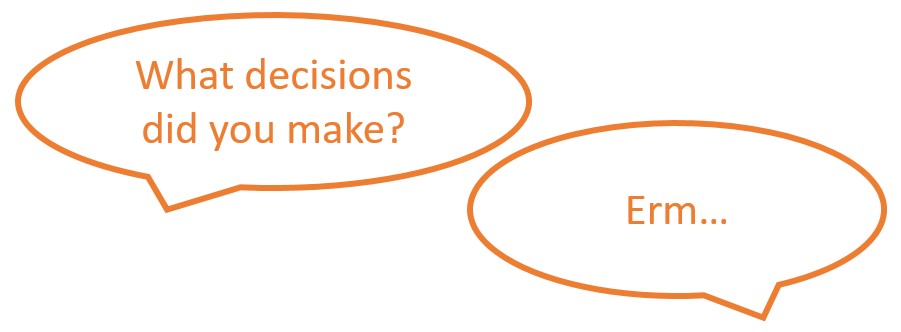
In this extract, the designer is asked what decisions he had to make when designing a trestle table for a university client. He initially hesitates, indicating that this is a difficult question. Then, rather than identifying specific decisions, he provides an account of how the process of designing involves lots of tiny, embedded decisions.
Interviewer: we can go into more detail afterwards but but what were the particular decisions that you had to make in designing this (.4) product
Participant: (2.8) erm (1.9) well decisions yeah (huhuh) i think designing is always decision-making erm
Interviewer: yeah
Participant: the whole time (.5) erm (1.9) i mean at the at the end of the day you have a (1.2) you have a certain erm er there was maybe like a vague idea by the university what they wanted and then it’s (1.0) our role as designers to give this idea (1.4) erm a form basically to to
Interviewer: yep
Participant: bring it into being (.7) and erm (.5) so (.4) decision making i would say is erm (1.8) er (1.0) well i mean there are there are lots of lots of tiny tiny decisions erm at the i mean at the very beginning erm you you develop maybe a erm a rather abstract idea of of how something could be and then through a iterative process of erm model making and sketching (.5) you erm (.6) you yeah you develop this idea but it’s erm (.4) oftentimes not so much that you (1.5) erm (1.0) only decide how things should be but (.4) that you erm do something and then the the thing that is in front of you (.5) maybe a drawing or a a model (.6) erm (.4) er speaks back to you and erm in a way erm so (.6) it’s erm and then then of course you react to it and erm and so (.5) there are hundreds of of decisions detailed decisions
From an interview with a product designer in Germany.
The designer in the next extract also hesitates to find an answer to the question of what decisions he had to make when designing shoe packaging for a client. In this case, he frames familiarising the client with sustainable materials as a decision. Instead of describing specific design decisions he made, he thus highlights the client’s role in decisions about materials.
Interviewer: yeah okay (.6) so could you tell me about some of the things that you had to make design decisions about
Participant: mm so (1.3) i think some of the biggest things um because this company that we worked with they had never (.7) done any like sustainably initiative projects before (.8) it was getting them familiar with the sustainable (.6) materials um (.6) you know
From an interview with a product designer in the USA.
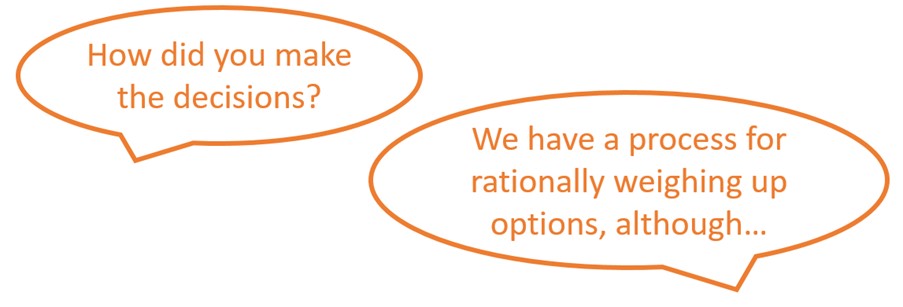
Some of the designers did manage to briefly articulate what constituted design decisions in a project, for example, related to functionality or materials. In the following extract, when the designer is asked how such design decisions were made, he describes a technical decision-making tool, which is used to help compare lots of different options in a grid. However, when pushed to describe how the final decision is actually then made, he frames his response as a sort of ‘confession’ that in fact, intuition is involved.
Interviewer: okay and could you tell me a bit about the design process and how you went about making decisions
Participant: (1.2) sure erm yeah i think i think we might have touched on our last call
Interviewer: yeah
Participant: i so i really (.7) er for this (.6) i really like a i quite like a process called morphological analysis
Interviewer: mhm
Participant: (1.0) erm which is where i essentially break down er (.7) the functions of the product you’re trying (.5) er to develop erm (.5) or you yeah you break down er the product the product into its kind of simplest basic functions
Interviewer: mhm
Participant: erm and then you can combine those to create erm (.6) concepts design concepts that you can then assess on how erm on how good they are
((lines omitted in which the participant describes why this tool is useful for a current design project))
Participant: so you’re just kind of combining
Interviewer: mhm
Participant: different kinds of possible options (1.0) erm then you are looking at those kind of final concepts (.8) for a variety of (.6) erm (1.2) criteria including things like (.4) cost and erm (.7) safety reliability maintainability and and also sustainability
Interviewer: mhm (.8) and (1.1) no carry on (heheh)
Participant: (heheheh) erm (1.2) yeah and then (1.4) yeah sorry what was your question was it
Interviewer: it’s is i’m interested in the process and you started talking about this (.4) particular approach or tool (.6)
Participant: mm
Interviewer: erm to (1.5) so how what does that look like are you doing this on paper and sketching or using a computer
Participant: (1.1) so you do yeah it’s kind of on paper and sketching you do basically every every little basic function you do a little sketch for
Interviewer: mhm
Participant: erm and then generally speaking you you draw it up (.4) either on paper or on you put those sketches into a computer and then you put it into a huge table
Interviewer: yeah
Participant: erm of kind of functions and then you you have them all going across and then you can just look at it and it’s very visual
Interviewer: yep
Participant: er (.7) er about whether you want to combine certain things erm so i i yeah i guess maybe a slightly better example as well is for electrical charge points is one of the basic functions it has to authorise access (1.0) to users and you can do this with things like an rfid card (.4) an app (.4) erm you know someone sitting there (.9) telling you you can access it or none of those things at all erm and so that’s again one of the basic functions on it and you can use you can choose any of those options erm
Interviewer: yeah and so you’ve got you’ve got all these options in a big grid
Participant: mhm
Interviewer: how do you actually then choose
Participant: (1.4) erm so it’s (1.0) yeah this is one of the (1.2) this is maybe one of slightly controversial bits about the process is it’s largely (.8) intuitive
Interviewer: mhm
Participant: erm or based on experience
From an interview with a product designer in the UK.
Key takeaway points
- Articulating what decisions were made and how design decisions were made in business settings is difficult. There may be various different people involved in a process of coming to a firm conclusion. Pinpointing when and how a decision has been made may not be possible.
- When designers give accounts of using rational methods for weighing up criteria, as recommended by design decision-making experts, in the end, they ‘confess’ to making final decisions intuitively.
- Product designers are increasingly held to account for whether more sustainable design decisions are made. But the designers studied claim to be influencing decisions rather than making key decisions about how sustainable products are.